
You've built a life around everyone else.
When do you get a say?
You've spent years being the woman everyone can depend on. The one who manages, organises, remembers, accommodates and somehow keeps everything moving.
And you're good at it.
But being good at something doesn't necessarily mean it's good for you.
I'm Sarah Pearson. I write and speak about the patterns we inherit, the expectations we accept and what happens when we start questioning the lives we've built around everyone else.
Somewhere along the way, you became responsible for everyone else's comfort.
You became the reliable one. The reasonable one. The woman who could be counted on to handle whatever needed handling. You learnt when to speak, when to stay quiet, when to compromise and when it was easier to do something yourself than explain why someone else should.And because you were capable, people kept expecting more. The problem is that these things rarely happen overnight.
Nobody sits you down and asks whether you'd like to spend the next twenty years putting yourself somewhere near the bottom of your own priority list. It happens gradually.
One compromise. One responsibility. One expectation at a time.
Until the life you're living starts to feel less like something you chose and more like something you're responsible for maintaining.
And perhaps the most uncomfortable part? You might have helped build it.
Not because you wanted to disappear into everyone else's expectations. But because some of the behaviours that made you successful, dependable and appreciated also made it easier to ignore what you needed.
That's worth examining.
You don't need another version of yourself to perform.
There's no shortage of people telling women how to become better versions of themselves. Better habits. Better boundaries. Better routines. Better attitudes. Apparently, we're all one morning routine away from having our lives sorted. (Convenient.)
But what happens when the problem isn't that you're failing to do enough? What happens when you've spent years doing too much of what everyone else expects, without stopping to question whether those expectations belong to you?
That's where my work begins.
Not with a list of things you need to improve about yourself. With an examination of the beliefs, behaviours and standards that have shaped the way you live. Because meaningful change requires more than deciding you want things to be different. It requires understanding why they became this way in the first place.

the shift method
Change isn't a personality transplant. It's a process. The SHIFT Method is a five-part framework designed to help women examine the patterns shaping their lives and make deliberate changes to the way they think, choose and act. It brings together honest self-examination, an understanding of learned behaviours, practical decision-making and the willingness to follow through when change becomes uncomfortable.
s
stop the bullshit
Before anything changes, you need to get honest about what's actually happening.
The excuses. The explanations. The things you're tolerating. The ways you might be contributing to situations you say you want to change.
Not everything is your responsibility.
But some things are.
Learning the difference matters.
h
heal the damn foundation
You didn't arrive at adulthood with your beliefs, behaviours and expectations neatly formed out of nowhere.
They developed through experience, relationships, conditioning and repetition.
This is where we examine what you've learnt about yourself, why certain patterns persist and which assumptions deserve to be reconsidered.
i
Inhabit Her
It's one thing to recognise that the way you've been living no longer works.
It's another to decide how you actually want to live.
This stage is about developing a clearer understanding of your values, preferences, needs and identity, without automatically measuring them against everyone else's expectations.
F
Follow Through
Awareness is useful.
It isn't the same as change.
Here we turn what you've learnt into decisions, boundaries, behaviours and commitments that can hold up outside the pages of a book.
Including on the days when reverting to familiar patterns would be considerably easier.
t
Take Up Space
You don't need permission to participate fully in your own life.
This final stage is about putting the work into practice. Speaking honestly. Making decisions. Allowing your needs, ambitions and opinions to matter.
Not as a performance of confidence.
As a different way of living.
What happens when the woman who holds everything together starts asking questions?
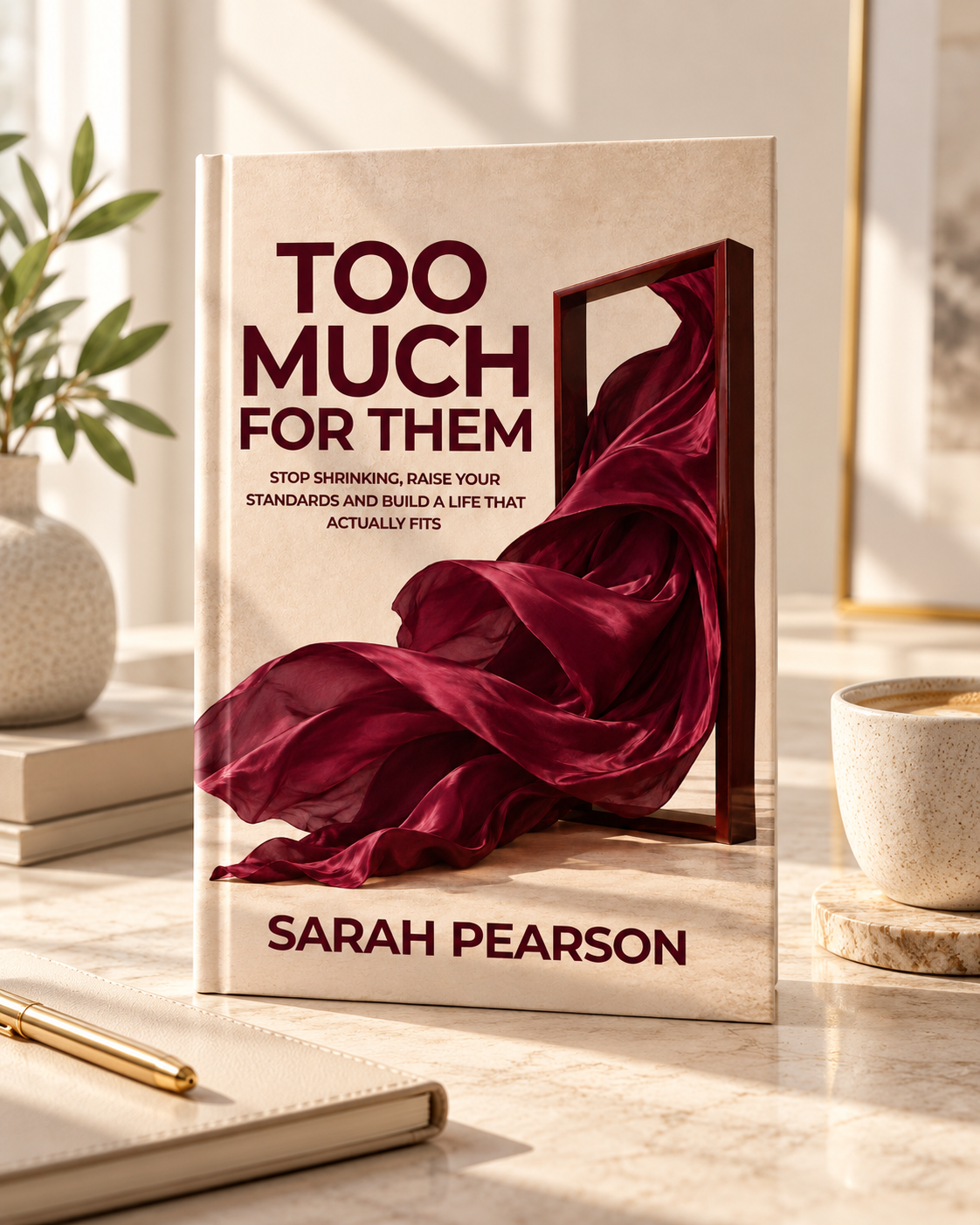
Too Much For Them is an examination of the expectations women inherit, the identities they build around those expectations and the uncomfortable process of deciding what no longer fits.
Drawing on personal experience, behavioural patterns and the SHIFT Method, the book explores the gap between being the woman everyone relies on and being a woman who has a meaningful say in her own life.
It isn't a collection of affirmations or a promise that everything changes the moment you decide it should. It's about looking closely at the choices you've made, the circumstances that shaped them and the work involved in doing things differently.
Some of it will be confronting. Some of it might sound uncomfortably familiar. That's the point.
THE EXPANDED NEW EDITION IS COMING IN 2027.
I'm Sarah
And I know a thing or two about holding everything together.
For a long time, I thought I had a pretty good understanding of who I was. Independent, ambitious, capable and reasonably good at dealing with whatever life decided to throw at me. I'd built a life I was proud of, worked hard for the things I had and become someone people could depend on. From the outside, everything looked perfectly fine. And for the most part, it was. But somewhere along the way, I started wondering whether the life I'd become so good at managing was actually the life I wanted.
I'd spent years being the woman who could handle almost anything. The one who found solutions, took responsibility and kept everything moving. I took pride in being capable, and I still do. But I'd also become very good at putting my own needs somewhere near the bottom of the list. Eventually, I started questioning how much of the woman I'd become was genuinely me, and how much was shaped by the expectations I'd spent years trying to meet.
Those questions became the beginning of Too Much For Them and eventually the SHIFT Method. Today, I write and speak about identity, expectations, ambition and the patterns that shape our lives, often without us even realising it. I'm interested in what happens when women stop accepting that being good at holding everything together means they should have to, and start making conscious decisions about what they actually want from their lives.